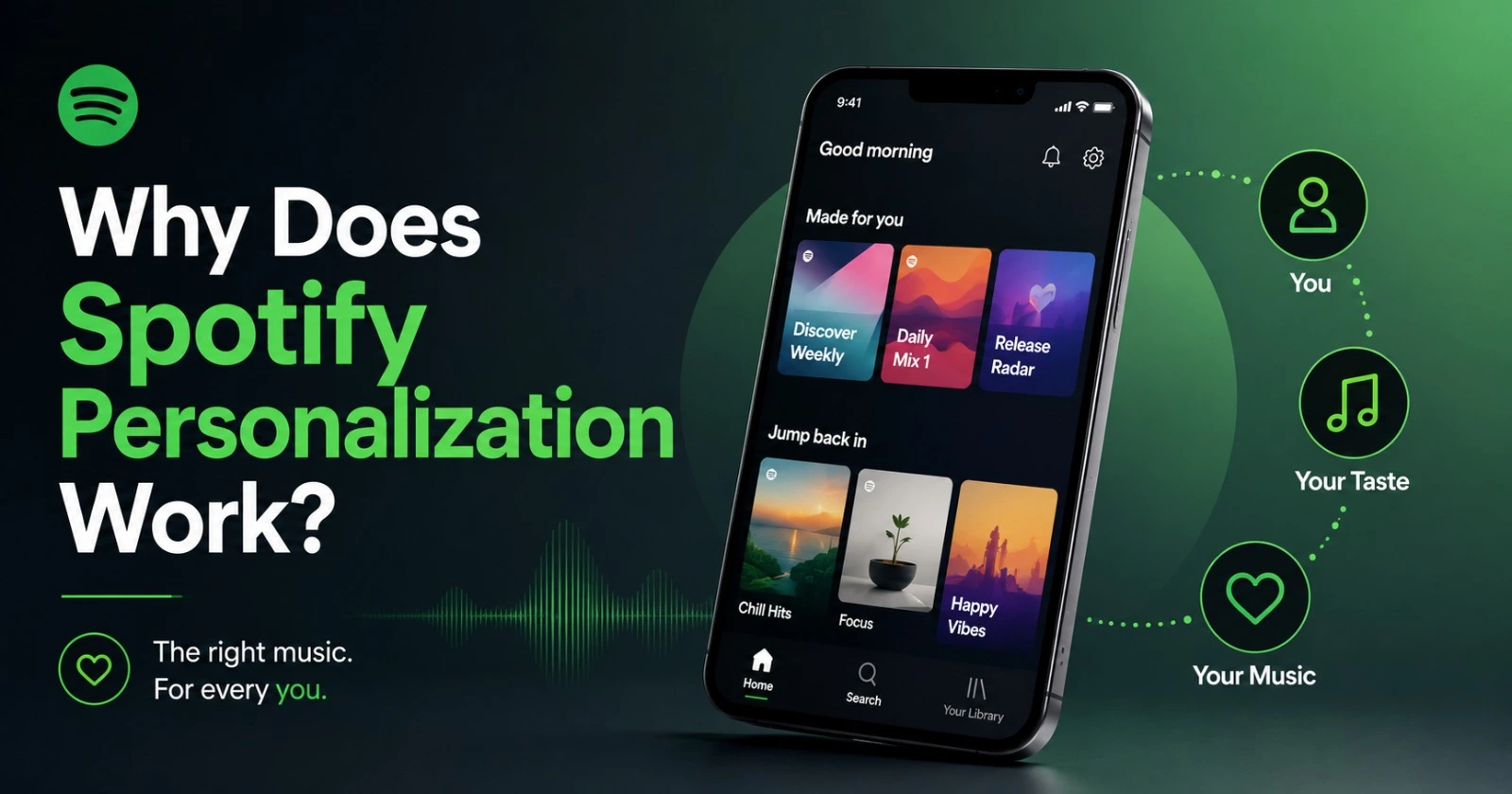
Have you ever opened Spotify and instantly found a song that matched your mood? That feeling is not accidental. Spotify Personalization uses listening activity to shape an experience around each user. Plays, skips, saves, searches, playlist additions, and interactions with artists can all provide useful signals. First, these actions help the platform identify patterns in individual taste, allowing recommendations to become more relevant over time without making every listener explore an enormous catalogue alone. This reduces choice fatigue and makes daily listening feel effortless and personal.
Spotify Personalization combines multiple algorithms with machine learning, data curation, and human editorial expertise. Spotify says the idea of one mysterious “algorithm” is an oversimplification. Moreover, editors contribute cultural knowledge, intuition, and context that machines cannot reproduce independently. Spotify calls this collaboration “algotorial” because algorithms and editors work together to select music for particular audiences and situations. This blend explains why the experience can feel both precise and genuinely human rather than mechanically generated.
Spotify Personalization suggests Strong recommendations must balance comfort with curiosity. Spotify Personalization learns which songs users repeatedly enjoy, yet it also looks for opportunities to introduce unfamiliar artists, genres, or releases. However, discovery cannot feel random; a new track should still connect with a listener’s established interests. Features including Discover Weekly, Release Radar, and personalized mixes reduce the effort of searching, helping listeners encounter fresh music while preserving enough familiarity to keep the experience enjoyable and trustworthy.
Context matters just as much as taste. Spotify Personalization can become more useful when it recognizes that listening choices change across workouts, commutes, study sessions, weekends, or quieter moments. Therefore, Spotify’s 2026 strategy describes experiences shaped in real time around a user’s taste, context, and intent. New tools such as Taste Profile and Prompted Playlists also aim to give listeners more visibility and control, making recommendations feel responsive instead of fixed.
Read more: https://mynkmedia.com/ai-generated-instagram-poster-reach/
Spotify Wrapped shows how behavioural information can become emotional storytelling. Spotify Personalization transforms a year of listening into an interactive reflection featuring favourite songs, artists, genres, podcasts, and habits. Meanwhile, the presentation turns statistics into a recognizable personal narrative that users often want to share. Rather than presenting a dull dashboard, Wrapped connects data with memory, identity, and community, proving that information becomes more engaging when people can clearly see themselves within it.
For marketers, the biggest lesson is relevance before promotion. Spotify Personalization feels valuable because it helps users decide what to hear next, instead of interrupting them with generic content. For example, brands can study browsing behaviour, purchases, saved items, preferred categories, or service history to simplify decisions. The objective is not to collect more data for its own sake, but to use appropriate, consented information to remove friction and improve each customer’s experience.
Personalization also needs transparency and control. Spotify Personalization becomes stronger when listeners can influence the system, correct inaccurate assumptions, and understand why certain suggestions appear. In addition, responsible brands should minimise unnecessary data collection, explain how information supports the experience, and offer meaningful preference controls. Trust can disappear quickly when personalization feels intrusive. Clear value exchange, sensible privacy practices, and customer choice ensure that relevance strengthens the relationship rather than creating discomfort.
The strategy works because it connects utility with emotion. Spotify Personalization does not simply predict a likely click; it helps soundtrack routines, discoveries, relationships, and memories. As a result, users receive an experience that can grow alongside their changing interests while still feeling familiar. Brands can confidently apply the same principle by turning customer signals into timely, helpful experiences. Finally, when people feel understood rather than targeted, they have a stronger reason to remember, trust, and return.