Search Is Becoming More Conversational
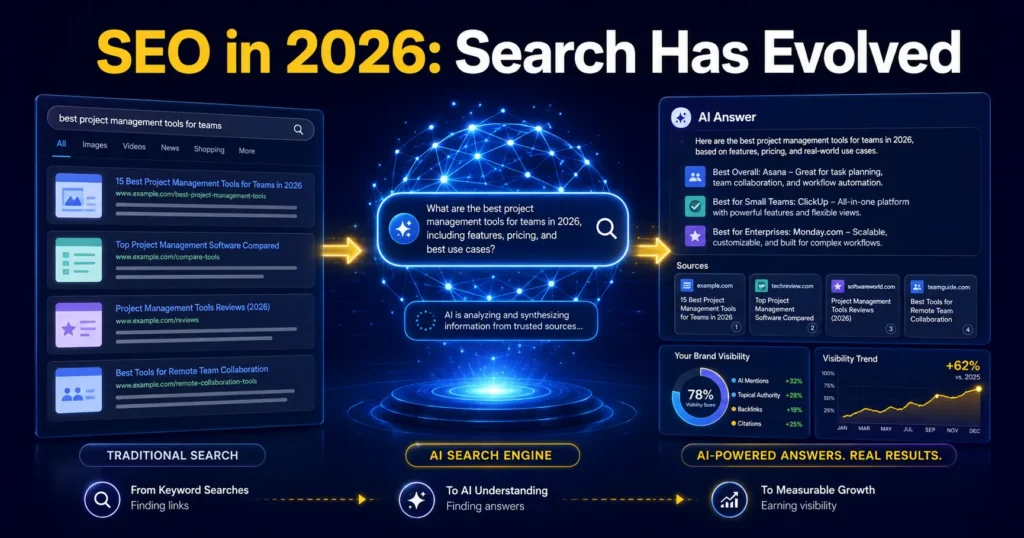
Search is becoming more conversational as Google expands AI Overviews and AI Mode alongside results. People can receive responses, explore linked sources, and continue with follow-up questions instead of starting new searches. This shift changes how information is discovered, but it does not eliminate useful websites. SEO in 2026 is increasingly about helping search systems understand trustworthy pages and helping users find deeper information, expertise, products, or services when an AI response is not enough.
The fundamentals remain important because Google’s generative features are connected to its ranking and quality systems. They retrieve relevant pages from the Search index and may display clickable sources supporting their responses. Therefore, SEO in 2026 still requires crawlable pages, accurate indexing, descriptive titles, helpful internal links, mobile usability, and a strong page experience. Businesses should maintain these foundations before chasing new terminology, tools, or tactics that promise instant inclusion in AI-generated results without evidence.
Original Content Matters More
Originality matters more when an AI response can summarise basic information that appears across hundreds of websites. Businesses need content shaped by experience, useful data, distinctive opinions, examples, and customer knowledge. Moreover, Google recommends creating helpful, reliable, people-first material instead of publishing content mainly to manipulate rankings. SEO in 2026 rewards a reason to visit the website, such as expert analysis, practical tools, case studies, demonstrations, research, comparisons, or insights that generic summaries cannot provide.
Content format also deserves attention. Images, videos, charts, and page layouts can improve understanding while creating more opportunities for discovery across different Search experiences. However, multimedia should support the answer rather than decorate the page. SEO in 2026 depends on making every resource accessible, descriptive, fast-loading, and useful on mobile devices. Logical headings, concise explanations, accurate image alt text, structured navigation, and crawlable links help people and search systems interpret the page without friction.
Read more: https://mynkmedia.com/zomato-notification-strategy/
Measuring Visibility and Business Results
Measurement is evolving alongside discovery. Rankings, impressions, and clicks remain, but they no longer explain the value of AI-powered visibility. Google recommends using the Generative AI performance report in Search Console to understand how people discover content through its generative Search features. Consequently, SEO in 2026 should include visibility monitoring across AI experiences while recognising that exposure is only the beginning. Reports should connect discovery with engaged visits, enquiries, subscriptions, purchases, and other business actions.
Visitor quality is important because fewer clicks can produce stronger outcomes when the users arriving are informed and more relevant. Meanwhile, businesses should review engagement, conversion rate, qualified leads, sales, and assisted conversions alongside traffic. SEO in 2026 requires asking whether content attracts the right audience and supports decisions. A page that earns fewer visits but produces enquiries may contribute more than a high-traffic article that answers a broad question without creating any commercial interest.
Avoid Unsupported AI SEO Tricks
Businesses should be careful with supposed AI optimisation shortcuts. Google says no AI-only writing style, tiny content chunks, machine-readable files, or excessive keyword variations are required. Additionally, Google Search does not use llms.txt to determine visibility, and special structured data is unnecessary for generative results. SEO in 2026 remains centred on useful content and technical implementation. New labels such as AEO or GEO do not replace the responsibility to satisfy users with accurate, accessible information.
Ultimately, the future of search belongs to businesses that become dependable sources rather than businesses trying to outsmart system updates. AI may change how answers are presented, but trust, relevance, originality, and usability shape whether content deserves attention. For example, SEO in 2026 can combine expert-led articles, technical foundations, multimedia, and conversion measurement. This approach helps a business earn traditional rankings, appear in AI-supported discovery, serve customers effectively, and turn search visibility into sustainable growth.