Attention Does Not Always Create Growth
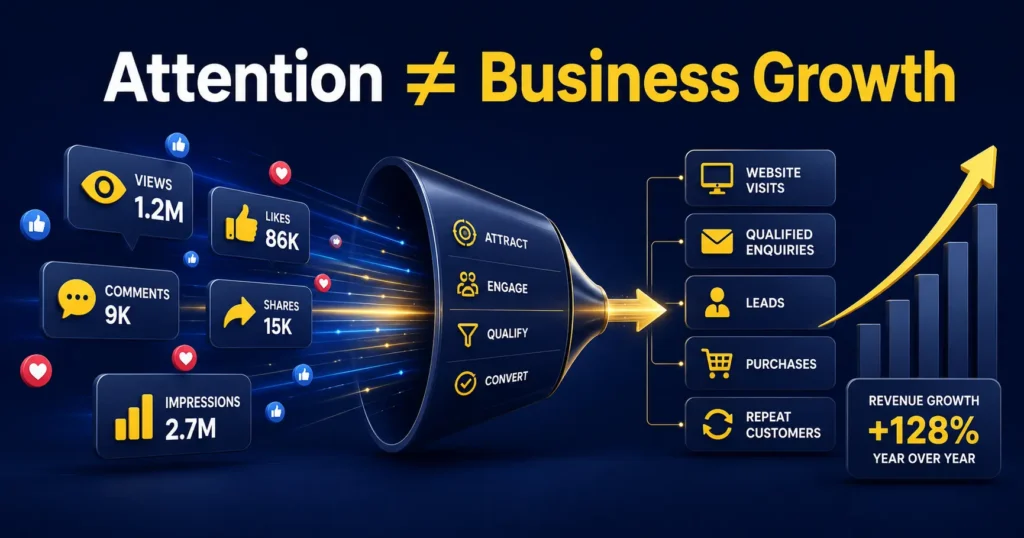
Brand Attention vs Business Growth: What Really Matters? Every brand needs attention, but visibility alone does not guarantee commercial success. A post may collect thousands of views, likes, shares, or comments without producing a single enquiry or sale. This clearly explains why brand attention matters more than business growth. Attention makes people notice, recognise, and remember a business. Growth begins when people take valuable actions, such as visiting the website, requesting information, joining a mailing list, purchasing a product, or returning as loyal customers.
Impressions and engagement are useful because they show whether content is reaching an audience. However, they become misleading when presented as proof of revenue, customer quality, or marketing effectiveness. Understanding brand attention vs business growth prevents businesses from celebrating numbers without examining their meaning. A viral post seen by the wrong audience may create noise, while a smaller campaign reaching relevant decision-makers can generate stronger leads, better sales conversations, and greater value for the company.
Examine the Complete Customer Journey
Marketers should examine the customer journey instead of one metric. Ask who saw the content, who engaged, who clicked, who explored the website, and who completed an action. Therefore, measuring brand attention vs business growth requires connecting awareness data with behaviour and outcomes. This approach reveals where customers lose interest. Reach with few clicks may indicate weak messaging, while traffic with limited enquiries could suggest problems with the offer, landing page, or call to action.
Conversions are the actions a business considers valuable. Depending on the goal, they may include purchases, sign-ups, calls, quotation requests, downloads, booked consultations, or completed forms. Google Ads recommends defining these valuable actions so campaign performance can be evaluated more meaningfully. Moreover, brand attention vs business growth becomes easier to understand when each conversion has a clear, specific purpose. Businesses can then compare channels, calculate acquisition costs, and determine which activities contribute to genuine results.
Read more: https://mynkmedia.com/seo-for-business-what-it-is/
Turn Brand Awareness Into Action
Do not stop creating awareness content. Instead, businesses should treat attention as the beginning of a path towards action. A practical brand attention vs business growth strategy attracts the right audience, communicates a problem, demonstrates expertise, and offers one next step. Consequently, every post should have a role. Some content may introduce the brand, some may build trust, and other content should encourage prospects to visit, enquire, subscribe, book, or buy when they are ready.
Content quality influences both visibility and what audiences do afterwards. Helpful articles, useful videos, honest explanations, and case studies give people reasons to trust a brand beyond a memorable headline. Meanwhile, Google’s guidance explains that its ranking systems prioritise helpful, reliable, people-first content rather than material created mainly to manipulate rankings. This principle supports brand attention vs business growth because useful content can attract appropriate visitors while also helping them make decisions about the business.
Measure the Results That Matter
Measurement should combine awareness, consideration, and conversion indicators in one report. Track reach, impressions, engagement rate, website visits, time on page, leads, conversion rate, sales, repeat purchases, and customer acquisition cost. Additionally, review the quality of enquiries rather than counting every lead equally. A brand attention vs business growth dashboard should show how people move between stages and which channels assist that movement. Monthly comparisons can then reveal patterns, weaknesses, and opportunities for better investment.
Ultimately, attention is valuable only when it supports a business objective. Brands need visibility to enter conversations, but they need trustworthy content, offers, simple user journeys, and reliable measurement to create growth. Brand attention vs business growth should not be treated as a choice between awareness and conversions; successful marketing connects both. For example, businesses can use content to attract relevant people, retarget visitors, and guide prospects towards actions that produce revenue and customer relationships.