Visitors leave your website without buying for many reasons, and high traffic does not always mean sales. A website can attract the right audience yet lose potential customers because of friction, confusion, or a lack of trust. Understanding why visitors leave your website without buying helps businesses identify weak points and create a smoother path from interest to purchase.
1. Your Website Loads Too Slowly
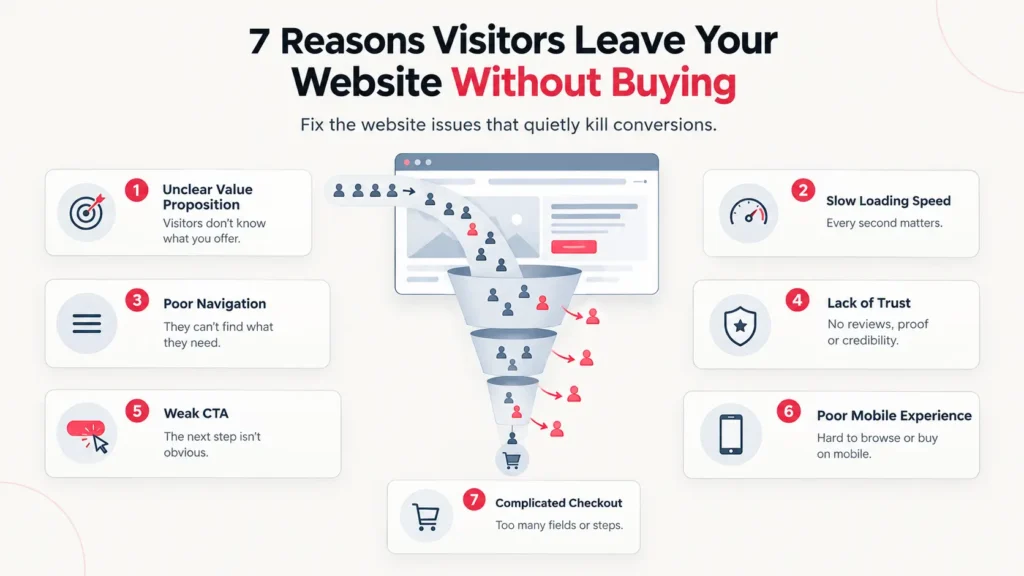
Speed has a direct effect on user experience. If visitors leave your website without buying because pages take too long to load, you may be losing customers before they see your offer. Google’s Core Web Vitals guidance recommends monitoring loading performance, responsiveness, and visual stability. Therefore, compress images, reduce unnecessary scripts, and test pages regularly.
2. Your Value Proposition Is Unclear
Visitors should understand what you offer and why it matters within seconds. If visitors leave your website without buying because your homepage uses vague headlines or generic messaging, they may struggle to see the product’s value. Instead, communicate the problem you solve, who you help, and what makes your solution different.
3. The Buying Process Is Complicated
Every unnecessary step can create another opportunity for customers to abandon their purchase. Visitors leave your website without buying when forms are lengthy, navigation is confusing, or checkout requires too much information. Baymard’s checkout research identifies checkout complexity as one factor that can contribute to abandonment. Consequently, simplify menus, reduce form fields, provide familiar payment options, and make checkout easy to understand.
4. Your Website Does Not Build Trust
Customers need confidence before giving you money or personal information. If visitors leave your website without buying because they cannot find reviews, testimonials, guarantees, contact details, or secure payment information, trust may be the missing ingredient. Baymard’s ecommerce UX research highlights trust and security concerns among factors affecting online purchasing. Moreover, displaying social proof and transparent policies can reduce uncertainty and help potential buyers feel comfortable.
Read more: https://mynkmedia.com/marketing-trust-gap-website-visitors-dont-buy/
5. Your Product Information Is Incomplete
People cannot confidently buy something they do not understand. Visitors leave your website without buying when product descriptions are too short, images are unclear, specifications are missing, or important questions remain unanswered. Include useful details such as features, benefits, pricing, delivery information, returns, and frequently asked questions. The more uncertainty you remove, the easier the buying decision becomes.
6. Your Call to Action Is Weak
A visitor may be interested but still unsure what to do next. If visitors leave your website without buying because calls to action are hidden, unclear, or inconsistent, your website creates unnecessary hesitation. Use direct language such as “Get Started,” “Request a Quote,” or “Buy Now.” Additionally, place relevant calls to action where users naturally make decisions.
7. Your Website Is Not Mobile-Friendly
A large portion of online browsing happens on smartphones, making mobile usability essential. Visitors leave your website without buying when text is difficult to read, buttons are too small, images break the layout, or checkout does not work properly on smaller screens. Google’s mobile-first guidance emphasizes providing a strong experience across mobile pages. Furthermore, test your website across different devices and browsers to ensure customers can purchase without frustration.
Fixing these problems starts with understanding customer behaviour. Use analytics, heatmaps, session recordings, surveys, and conversion data to discover where visitors hesitate or exit. Finally, test improvements instead of changing everything at once. Visitors leave your website without buying for different reasons, so evidence can help you determine whether speed, messaging, trust, usability, or checkout is the main barrier.
Traffic is valuable, but conversions turn attention into business. When visitors leave your website without buying, do not immediately assume you need more traffic. First, examine the experience you provide after someone arrives. Remove friction, strengthen trust, clarify your offer, and make purchasing simple. Ultimately, a website that respects the customer’s time and answers their questions is more likely to turn visits into sales.